Wednesday, April 26, 2006

Why TiE members are scared of blogs?

When you think of TiE, you think of people who live, breathe, and dream technology. However, there is one area of technology that has not caught the imagination of the TiE community: blogging. And here is why:
  1. A survey early this year by TiE-Boston of its membership base to find out the number of bloggers elicited just three responses.
  2. TiE Boston has never addressed the issue of blogging in any talk/speech/panel discussion - probably, one of the most remarkable technological developments during last two years.
  3. The TiECON blog has been a disappointment on two metrics: number of links from TiE Boston members pointing to the blog and the number of comments left.
How to leverage blogs for personal and professional success?

There is enough information in the public domain about the value of a blog and I don't need to repeat that here. So here are some tips on how you can make blogging a part of your professional life:
  1. If your boss/employer lives under a stone, or has never heard about blogs, or has never read/written one, and bans you from blogging, take the time to teach her/him the basics of blogs and how they are a great business tool. Cite examples of companies like Microsoft and Sun Microsystems that are very effectively using blogs for internal/external communication.
  2. While you are encouraged to read your employer's HR policies, generally speaking, an employer has no control when you blog during your private time (though I consider blogging as a business activity if the blog's focus is related to your area of work) as long as you do not divulge company secrets in your blog. Thus, if you work for a semiconductor company, you can blog about semiconductors provided you do not share information that is not meant for public consumption.
  3. If you would like to improve your writing skills, join a creative writings class. In the meantime, start a blog talking about your family or hobby or vacation. Great way to become familiar with the tools.
  4. If you are cheap, open a blog at Blogger. Otherwise, get your own domain name and blog like a professional - I only spend five bucks a month for my blog.
  5. And if you think bloggers are wasting their time, think again. Apart from the brand that I have built, I make a pretty respectable living.
So here is the challenge. Start your blog, come back here, and add a comment below pointing to your blog. Or even better, blog about this initiative on your blog. It will be nice to see a few more bloggers in the TiE community.

- By Jay Dwivedi, who not only blogs for himself but blogs for TiE too.

Tuesday, April 25, 2006

Is digital media convergence a meaningful concept?

Let me start off with a caveat. The discussion here will focus on next 6-12 months since I believe that with the pace of technological change in this space, to predict anything beyond that is merely entertaining ourselves with fantasies.

Convergence is a concept that has been pushed by technologists for years but consumers have largely rejected the concept. While there are numerous examples of how consumers prefer to consume their media to have the most enriching experience, let me just discuss one case study to illustrate the point that any discussion of convergence is more complex than it appears to be.

Camera phones Digital camera phone sales data

Camera phones started to become available on a big scale during the 2002-2003 period and by 2004, they took off - selling about a quarter billion units that year. I have not seen the final numbers for 2005 yet in the public domain, but the estimates range from 280 million to 300 million units. If you add it all up, some estimates indicate that there could be as many as one billion camera phones out there.

You would expect then that consumers must be going nuts taking pictures with their camera phones. On the contrary, if you take a look at Flickr, almost all photos are taken with a full-fledged digital camera. I think a phone camera does make sense when you are sipping a martini at "Pure" and Paris Hilton walks in. You quickly snap a few photos to post on your blog the same day or even blog by email almost immediately. However, when you want to build a good photo album online or to print your pictures, a digital camera is the only option.

And what consumers are indirectly saying is supported by Kodak research. The company found that nearly two-thirds of camera phone owners rarely, if ever, upload pictures to a computer. And 70 percent never (or rarely) send photos to other phones. In other words, consumers understand that mobile phones are best suited for having a phone conversation - not for taking pictures.

Where are we likely to see convergence?

Consumers are saying that they are willing to use some applications of convergence. For instance, most sane people do not watch "The Daily Show" on their computers, but if they miss an episode and there is particularly funny clip, they don't mind looking at only that clip (not the whole episode) on the web. I have seen people kill time playing games on their mobile phones while waiting in line at the RMV, but don't expect these game enthusiasts to abandon their PS2 or XBOX. There are numerous other instances of how convergence is happening on a limited scale.

What does it mean from an investment perspective?

Just because a bunch of technologists have come up with something they think is "cool," it doesn't mean that it is cool for an average consumer. Merely packing more features in a device may actually be counter-productive, making it bulkier, slower, less user-friendly, and expensive. So as you evaluate a potential new product and when you have listened to those entrepreneurs who think that their device will change the world (remember the refrigerators connected to the web - not many of them are sold each year), step outside the conference room and show it to a bunch of teenagers. You will get better data on the potential that way.

How to learn more?

If you are excited by technological developments in the world of media, entertainment, and technology, and want to find out where the business opportunities lie, I invite you attend a panel discussion on the topic of convergence at TiECON moderated by Josh Bernoff.

- By Jay Dwivedi

Monday, April 17, 2006

Biotech sector needs innovation, not government help

If Christopher R. Anderson, president of the Massachusetts High Technology Council, is really speaking on behalf of the state's biotech/pharma industry, it is disappointing to see that the industry is running away from innovation and wants to use regulation as a way to protect its turf.

In an opinion piece in Mass High Tech "Drug importation is bad policy and bad politics," his arguments sound so outdated in 2006. Here we are living in a world that seems to flatten each day, and apparently the Massachusetts biotech firms are arguing for more regulation, rather than for opening markets globally.

Anderson argues against free trade in drugs for the following reasons:

  1. It harms the state economy. In the short run, it absolutely will (companies that resist change may go out of business, some people may lose jobs, etc.), but the solution is not protectionism. The right approach will be to develop a more powerful business model that takes into consideration the new reality - a flat world in which drugs will soon move as freely as apparel or electronics do.
  2. It puts patients in harm's way. First of all, this issue is not yet settled. Both the FDA and the GAO have admitted that amount of data that they have collected on imported counterfeit drugs is extremely small. Since it is illegal to import, many crooks are currently in business. In other words, if it were made legal, legitimate companies will emerge and do what is needed, and checks and balances would be put in place to guarantee safety. The way we have systems in place to assure safety of pharmaceutical ingredients (that's right, we import a lot of fine chemicals that eventually end up in prescription drugs) from overseas, we can also have the same safety systems for drugs.
  3. It harms the drug discovery pipeline. No, it doesn't. To say so is to resist change and to try to transform your business model. If the cost of development of a drug is high (~ $1 billion), and that is a good enough reason to argue for trade barriers, somehow reminds me of the steel industry. We are seeing that in many other sectors (IT, software, business services, auto, etc.), where the cost of business has been fairly high, companies have found ways to optimize their supply chains and lower their costs to stay competitive.

The only good news is that some pharma executives can see the future and are already redesigning their business processes using some very innovative approaches. If you are a biotech executive and see the current business environment as an opportunity (rather than a threat) to transform your business, I invite you to attend sessions on "Cross-Border Models of Life Sciences: A View Across the Value Chain" and "Global Sourcing in a Flat World" during TiECon East 2006.

Recommended article: How to innovate in a flat world?

- By Jay Dwivedi

Wednesday, April 12, 2006

How to innovate in a flat world?

Many business people that I have met have this wrong idea that innovation is something that techies need to worry about - something that needs to be discussed in the R&D group meeting rather than the boardroom. The concept of innovation is so powerful that it can be applied to each and every aspect of doing business - in other words, to the business model itself. And as we contemplate the theme of TiECON, here is an excellent case study of how we can all take advantage of flattening world to drive our costs down and enhance the customer experience.

According to a story in the New York Times, "The Long-Distance Journey of a Fast-Food Order," Matt Richtel reports that when you drive up to some McDonald's locations, do not assume that the person you speak to to place your order is working inside the restaurant (old model). On the contrary, that person is a customer-service rep at a call center (in California). The order is transmitted to the restaurant almost immediately and is prepared for you during the time it will take you to drive to the pickup window.

How does McDonald's create value?

  1. It lowers the cost of doing business. Employees who traditionally answer the phone can be eliminated or asked to do prepare the order in a shorter time.
  2. The company can train a small group of reps to treat customers more consistently. For fast food restaurants it is a nightmare to train teenagers and employees (most of whom do not speak English as their first language) to be courteous and efficient.

Will the call center move overseas?

You bet. Since this is only a trial, I expect that eventually your order may be taken by call center employee in a less expensive location.

What a great way to make optimum use of resources scattered globally!

- Posted by Jay Dwivedi

Friday, April 07, 2006

Opportunities for exporting to India

A big deal is being made by Indian politicians about the jump in their exports to 100 billion dollars (I think they are still measly compared to China at over $700 billions), but that is not what was interesting to me. I was actually more curious about what India was importing. Like us, India is also importing more than it exports. Of course, oil and petrochemicals have a role to play, but if I exclude those products, the market for foreign products in India is just shy of 100 billion dollars.

And what are Indians importing?

I found the list to be somewhat interesting. There were things that I did not expect. Here are the top five categories:
  1. Natural or cultured pearls, precious or semiprecious stones, precious metals, jewelry, coins, etc. 18%
  2. Nuclear reactors, boilers, machinery and mechanical appliances, etc. 8.5%
  3. Electrical machinery and equipment and parts thereof; sound recorders and reproducers, television image and sound recorders and reproducers, and parts 7%
  4. Iron and steel 4%
  5. Organic chemicals 3.5%
- By Jay Dwivedi

Wednesday, April 05, 2006

How to improve infrastructure in India?

While I have been advocating investment in India, but one of the things that frustrates me as that when I try to dig opportunities there, the sad state of infrastructure in the country is a serious risk. The moment you land there, you realize that India has a long way to go. And I am not even talking about other things that make doing business in India so difficult - widespread corruption and clueless bureaucrats.

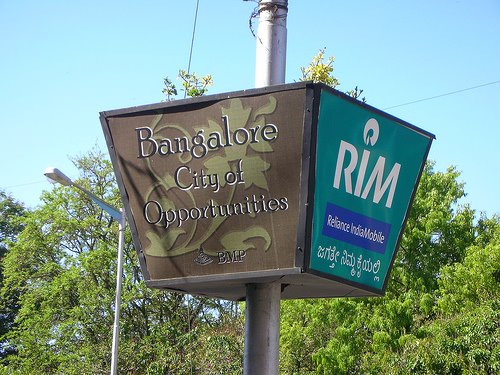
Photo of a sign in Bangalore, India

I do not intend to use this post to whine about inadequate infrastructure in India or the nuisances of doing business there. On the contrary, let me point out how you can make a difference this year at TiECon.

As I had mentioned in a previous post, I am particularly delighted to know that we have a few folks attending who can actually do something about the infrastructure. That's right; we have several members of Indian parliament who will be attending.

While each one of you may have your own wish list and you are welcome to discuss it with them, but here are two broad guidelines on what you must definitely try to highlight:

  1. No infrastructure, no investment: Unless the state of infrastructure improves, you will NOT consider making major investments. Like any risk management analysis will point out, a country that cannot provide reliable sources of power, transportation network, and telecom is low on the attractiveness ladder. It is not that we are playing hardball - it is just the way we have to manage our investment risk.
  2. Deregulation and privatization to encourage investment in infrastructure: When investors allocate capital for infrastructure that should have been provided by someone else (not necessarily the Government) at a much lower cost, nobody wins. In other words, when companies set up their own mini power plants at their facilities, everybody loses. Therefore, the lead on this has to come from the policymakers in form of deregulation and privatization.
UBS did a report in which it found that ROCE in India during the 1998-2003 period was 17% versus 11% in China (the actual number may actually be much lower due to subsidized capital in China), and the productivity/competitiveness in India is far higher than that in China, but it still lags China in attracting investors. We should tell policymakers the reasons.

- By Jay Dwivedi

Photo courtesy: Tom Maisey (Used under creative commons license)

Wednesday, March 29, 2006

How to exploit the Indian capital market?

First things first! A reminder that the discounted rates for registration will last only till Friday so if you would like to save, you must register right away.

--------------------------------------------------------

And now to more important stuff!

It is very tempting to think of India as a third-world country (which it is) that can only provide cheap labor, not just for BPO but also for value-added work like analyzing X-rays or pharma research or tax accounting. In our cost-cutting obsession, however, we may be overlooking what else India may have to offer.

Previously I have talked about tapping into the consumer market that is exploding in India. I have also emphasized the need for innovative business models to target the Indian consumer, but there is another path to participating - through investment into public companies.

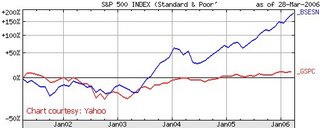
As the chart below shows, the Indian stock market (Bombay Stock Exchange index in blue) is at an all-time high. When I plotted it against S&P500 (in red), the first thought that struck me was that for some of you it may already be somewhat late to enter. While I do not expect the market to drop in the near future, I do expect that it will continue to rise at a steady pace for one simple reason - it started from a very small base and only now it has arrived to a point that global investors are taking it seriously. In other words, it still has a huge upside potential though do not expect it to double in less than three years.


So how do you capitalize on some of the emerging areas of growth and maximize your return? How will the current economic policies impact India's growth? These are some of the issues we plan to dwell on during TiECon. And do not forget that this time we are going to have several Indian policymakers at the conference. And while they will get an opportunity to make their pitch on why we should invest in India and their efforts towards further liberalization in the financial and retail sectors, we also will get a chance to impress upon them the changes that we would like to see so that Bombay Stock exchange will be as easy to navigate as New York, London, and Tokyo exchanges are.

What do I recommend?

If you are a sell/buy-side portfolio manager or analyst, investment banker or an economist, TiECon will provide an excellent opportunity to get a first-hand understanding of the capital markets in India. And the session I recommend is the one entitled "Emerging Trends: Cross Border Investing" on June 16 at 0115 PM. And while many attendees find it difficult to attend sessions on Saturday, if you are serious about studying India as a potential investment opportunity, I also recommend that you come just for the "Investing in India" session right after lunch.

Related article: Investment opportunities in India

- Posted by Jay Dwivedi

Tuesday, March 21, 2006

Investment opportunities in India

In my previous post I had discussed the somewhat gloomy investment climate in the United States. While we continue to make modest investments in highly promising ideas, we are taking lesser risk than we did just a few years ago. A lot of this shift in investment patterns is driven by the returns we are currently getting. As pointed out in the 2005 Venture Capital Report by Wilmer Cutler Pickering Hale and Dorr (a TiECON sponsor), a very successful sale today is a fraction of what we used to get. For instance, the report says, last year just two venture-backed companies were purchased for more than half-a-billion dollars and only 15 were purchased for more than a quarter billion. Ouch!

So where are the most attractive investment opportunities?

Apart from China, which continues to attract high levels of investment, India is another attractive market. Venture capital investment has crossed over $1B in India. And according to projections, the India biotech sector hopes to generate investments of $10B by 2010.

The country is experiencing GDP growth rates that are 2-3X of US GDP growth. The Venture Capital Report predicts that more VC firms will invest in overseas companies, sometimes with a local investment partner. I do not expect that most investments in India will result in billion or multi-billion dollar deals that we would like to see, but my research shows that the time horizons for an IPO can be relatively shorter and probability of a higher return on investment (ROI) higher in India during the next 3-5 years.

How can you get a first hand understanding of the investment climate in India?

As you plan your schedule for the conference, you might want to attend the session "Emerging Trends: Cross Border Investing" on June 16 at 0115 PM and another session at 0200 PM on June 17th that focuses specifically on investment in India.

Other related post: Using innovative business models for India

- Posted by Jay Dwivedi

Monday, March 20, 2006

India emerging as a consumer market

If you have not seen Sanjay Kadaveru (co-chair of the organizing committee) around for a while, there is a reason for it - he is networking with Members of Parliament (MPs') in India. The Indian Parliament is like our Congress and its members play an important role in policymaking. MP's also make an effort to bring investment to their districts.

And here is the update. We have confirmation from as many as five MP's to attend TiECon East 2006, including Madhu Yakshi and Sachin Pilot. They will be the members on a panel on infrastructure and governance in India.

Why are we inviting Indian policymakers?

As many of you have experienced during last 2-3 years, TiE has gradually evolved into a conduit to investment opportunities in India (either directly through network access that it provides or through entrepreneurs that choose to have management teams based in the US while locating the development and other process in India). By providing access to Indian policymakers, not only are we ensuring that they understand what we need from them, we are also giving them a chance to demonstrate to us what they will do for us to attract our dollars as they highlight India's transition from a offshoring to a market opportunity.

India's role in global economy changing from a BPO center to a consumer market

India's recent entry into the global economy was triggered by our desire to cut costs by offshoring low-end jobs. While most experts agree that relocation of these jobs has benefited American corporations, there has been another unintended social/economic outcome - India can now claim to have a real middle class that has rapidly growing discretionary income. In many cases, they are already consuming what we take for granted. During a recent trip, my jaw dropped when I was invited to visit the Shipra Mall on the outskirts of New Delhi - it was better than some of the malls in the Boston area, according to my wife who knows this better than I do. And the prices were actually higher than those in the US for most product categories since these new malls predominantly carry luxury goods by Indian standards.

In summary, it may be the right time to look at the country as a growth opportunity. You might also want to read my thoughts on why you should build a new business model for India if you want to serve the Indian consumer.

- Posted by Jay Dwivedi

Friday, March 17, 2006

Five reasons to register now

Al Kapoor and Sanjay Kadaveru, the co-chairs of the organizing committee, gave a very strong reason yesterday for you to register right away. Only the first 400 registrants will be able to reserve a seat in the special pre-event reception with Clayton Christensen - “How to predict whether your idea would succeed or fail.”

However, for those of you who are planning to attend, but have not registered yet, here are four more reasons why you should register now:

  1. TiECON East is organized entirely by a group of volunteers. The longer you hold off on registering, the more we have to focus on marketing/advertising. Not only does this cost money, it also takes away valuable time of our volunteers who would rather focus on making the conference itself better, than making phone calls or sending reminders to you - not the best utilization of our talents/time. For instance, I would rather do the research to tell you about how to improve venture capital activity or how to start your networking now or why we need need new business models for India, than to write posts like this one. In order to keep attracting the best pool of volunteers each year, we want to make sure that they get to work on challenging assignments and focus on what is important.
  2. TiECON is a not a profit-making machine. Whatever money we can save in marketing/advertising will help you, the conference, and the organization.
  3. We do not have rigid cancellation policies. If you register now and realize later that you cannot attend the conference, just call the TiE Boston office. We are very accommodating.
  4. And finally, while TiE gets a hundred bucks less if you sign up now, everyone is still better off if you register early.

Posted by Jay Dwivedi

Tuesday, March 14, 2006

How to improve venture capital activity?

I just received my copy of the 2005 Venture Capital Report from Wilmer Cutler Pickering Hale and Dorr LLP (a TiECON East 2006 sponsor) and a few things stood out. Over the next few days I will be picking a few relevant findings for you to ponder as you prepare to attend the conference which is just about three months away.

2005 was not a great year for financing of new ventures

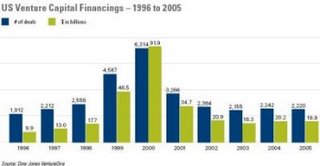
As the chart below shows, while things have stabilized since the downturn started in 2000, we are still at the same level as we were in 1997. And if you are not depressed yet, the report says, "We do not see any developments of trends likely to result in a significant change in the level of venture capital investments in 2006." Ouch!Chart showing the venture capital financing activity from 1996 to 2005 in the United States

So what went wrong?

  1. There are fewer high-quality investment options.
  2. My research shows that investors have become better at managing risk and no longer trust the entrepreneurs as they did in the past. While it means better scrutiny of business models and working with more conservative estimates, it also means that some promising ideas do not get funded.
  3. Lack of innovation. That's right. Those of us who watched what happened during the 90s remember very well that some of the best ideas came from innovation (not slick marketing). For instance, e-commerce, nano-technology, broadband, etc.

What can we do to energize the investment climate?

While a lot of TiE community members are too excited about globalization of venture capital activity and argue that merely investing in India and/or China will somehow solve all the problems in the world of investing, the reality is that smart investors do not invest in companies that plan to merely sell more widgets (at some point all markets commoditize). They are desperately trying to find the startups that come up with new business models.

In summary, as you work on new business ideas or seek funding for your existing business, take a look at the degree of innovation in your business. We often tend to forget the importance of innovation, as Clayton M. Christensen (a speaker this year) would tell you.

Posted by: Jay Dwivedi

Wednesday, March 08, 2006

How to start networking now for TiECON?

So you have signed up for the conference and are planning to show up in June at the Hynes Convention Center. In the meantime, you have no other plans for the conference. If that describes you, here are a few tips for you to start your networking now and to get the best out of your investment in attending.

How to network prior to the conference?
  1. Develop a list of specific individuals/organizations that you would like to contact. You can get ideas by reviewing the list of sponsors/speakers/attendees. If you are not sure about who to reach out to, just pick up the phone and call someone that you know within the TiE community or the TiE Boston office.
  2. Identify the right individual. This is extremely important since chances that you will make the right connection will depend on who you try to network with. For instance, unless you are a C-level officer in a Fortune 500 company, you might want to avoid contacting Rajat Gupta directly. Identify someone who will benefit as much from you as you would from her/him. Peer-level networking is always the best way to get started and then you can find your way up through that initial contact.
  3. Make the initial contact. Start off by establishing the TiECON connection (you/your colleague is speaking; your firm is sponsoring, etc.). Then quickly get to why you would like to establish a relationship (planning to run my business plan by a few industry experts; have an established business, but need growth capital; interested in investing in India biotech sector and need to identify investment opportunities; etc.). Suggest next steps (would like to email more information; set up a time to talk prior to/during the conference; etc.).
Hopefully, you will do fine from here on. Remember that almost everyone that is attending the conference is there to meet people that can help them succeed professionally. As long as you can make that happen for them, they will be delighted to network with you.

I will share more tips on networking at the conference in a separate article.

- Posted by Jay Dwivedi

Friday, March 03, 2006

Using innovation to do business in India

Anu Chitrapu is right. India has been a lot in the news lately because of the World Economic Forum and the visit by President Bush to India. And it is very encouraging to hear that the President appreciates the forces of globalization and how they are likely to benefit the whole world. "People do lose jobs as a result of globalization and it's painful for those who lose jobs," the President said and strongly defended the outsourcing of American jobs to India as the reality of a global economy. He added that the US should instead focus on India as a vital new market for American goods. Which brings me to something that I want to talk about - Innovation!

Finding business opportunities in India

We in the world of investors, venture capitalists, and entrepreneurs tend to focus so much on the ~300 million people (the so-called Indian middle class) that we overlook the rest of the population (~2.5X of this number). In my opinion, any idiot can sell to the Indian middle class by treating it as just another market segment that happens to be growing at 3X the US GDP growth rate. These people speak/understand English, desire American products, are seeing huge growth in disposable incomes, and are ready to spend it on consumer goods. But where is the innovation here? Where is the value created? In no time, India too will become like the United States (price-based competition in every sector leading to erosion of profits) and if there was no value proposition to begin with, your Indian business may be in trouble. We all know what happened to the so-called Asian Tigers.

Need for new business models in India - only true innovators will create shareholder value

What will distinguish the "me-too" businesses from the true innovators are the new business models are:

  1. Products and services that can be consumed by a broader section of the Indian society, not just the middle class.
  2. Offerings that are less susceptible to commoditization.

And both these elements of the business model can only be achieved if we wear our "innovation hats" and think creatively about a new value proposition.

So when President Bush is challenging American companies to stop fighting globalization and see it as an opportunity for innovation, he is alluding to cell phone companies that have made cell phones affordable to the Indian masses or the companies that are trying to sell the Rs. 10,000 PC or the Rs. 100,000 family sedan.

I am hoping that as we delve into these issues at TieCon East 2006, we will get an opportunity to hear about some new business models. In other words, how do we leverage innovation to create more compelling value propositions.

- Posted by Jay Dwivedi

Thursday, March 02, 2006

India in the news

It is amazing to see how much India is in the news nowadays. I don’t mean just now – that is expected with President Bush’s visit – but this past year I have seen more news articles than I could read on India. My favorite article is the one called “Davos days and Bollywood nights” which talks about India at the World Economic Forum conference at Davos this year. From being a country that was barely noticeable in Davos, India went on to center stage with a pomp and glory not associated with a third world country. The so called “poor” country was greeting all guests with a goody bag filled with great gifts from India including a pashmina shawl, some ayurvedic oils and an ipod with Indian music! The most striking thing was that India sent 115 delegates compared to China with 30.

Talking of China, there have been quite a few articles on India Vs. China too. At MIT Sloan we are now offered a course on India Vs. China taught by Professor Yasheng Huang, an expert in the field. There was also the New York Times editorial which talked about how the infrastructure in India is bursting at its seams. Airplanes apparently circle above the airports in Bombay and Delhi and waste precious fuel all because there are not enough runways and gates at the airports. But with all the FDI coming into the country I think it is just a matter of time before India fixes its infrastructure problems.

The TiECON organizing work is picking up intensity. We are all very excited with the keynote speakers. If you have not done so already check out our speakers.

Anu Chitrapu

Tuesday, February 28, 2006

Play quizzes, have fun, and network

Over the years as we have organized the conference, a common theme that we hear is about more networking opportunities. Like other years, we are working hard this year as well to find new ways for you to meet the type of people that you want to.

If you look at the agenda, you will notice that there is plenty of time for networking (we will give more tips on how to network in a subsquent post), but how about starting some networking now.

Yes, we have just launched a quiz program for you to start networking the fun way. You build a team, participate in quizzes, and network in a more informal atomosphere. For those of you who cannot make it to the quiz, there is the option of an online quiz (you can participate in both quizzes also).

Monday, February 27, 2006

Ray Kurzweil joins impressive list of keynote speakers

Who could have been a better speaker than Ray Kurzweil to speak on innovation? Not only is Kurzweil an entrepreneur (he has successfully founded and developed as many as nine businesses in such diverse areas of technology as OCR, music synthesis, speech recognition, reading technology, virtual reality, financial investment, and cybernetic art - in almost all cases leveraging artificial intelligence), he is also a visionary and futurist. And for a lot of people like me, he inspires us as a prolific writer and blogger.

Kurzweil joins what is emerging out to be an excellent slate of keynote speakers that includes Kofi Annan (UN Secretary General), Clayton M. Christensen and Howard H. Stevenson (both professors at Harvard Business School), and Rajat Gupta (senior partner at McKinsey).

Photo of Ray Kurzweil
- Posted by Jay Dwivedi

Monday, February 20, 2006

Marketing TiECon East 2006

The marketing team finally had its first "real" meeting. It is amazing how much work can be done virtually. We all recognize that marketing TiECon in 2006 is a monumental task since we are looking to make a monumental improvement in attendance.

And who will market TiECon East 2006?

You! Being a non-profit organization means that we do not have the resources for advertising. Every dollar that is spent on marketing means that either we raise the registration fee (something no one wants) or we cut back on the quality of the conference (again, something that no one wants).

So we are relying on people who already know TiE as an organization or have attended other TiE conferences or events to reach out to their colleagues, peers, and friends. If you see the value in being a member of this organization or attending the events, particularly TiECon, then we ask you to let others know about it. And in doing so, if you need our help in any way, just ask. You can simply shoot an email to the TiE Boston office.

Posted by Jay Dwivedi

----------------------------------

Tags: - - -

Tuesday, February 14, 2006

TiECON Blog

Hello!

We are about 4 months away from TiECON 2006. Things are falling into place and the level of activity amongst the organizers has increased perceptibly. The flurry of emails, the weekly phone calls, the planning meetings – all of these have reached a new heightened level of intensity.

I have had numerous conversations with Sanjay, one of the co-chairs, on projects that I could be involved in and the one that seemed right up my alley was the “Blog” project (I am trying to come up with a better name for this but for now “Blog project” it is). I am an official blogger (if there is a term like this) for MIT Sloan. I maintain a journal on my life at Sloan for applicants, students and others interested in the school to know more about Sloan. It is fun to write a blog for many reasons. One, you chronicle your life digitally which is very cool, two, there is a high probability you will be recognized because of your blog and three because you will never be bored with nothing to do.

We have great plans for the TiECON blog project. We envision the blog site to be a place where business leaders will share anecdotes about their lives, their business endeavors etc. In addition, our charter members will talk to us about various things they are involved with. The coolest part is the podcast initiative. Given the fact that many of the potential bloggers are very time constrained, we thought of an easy way for them to blog. Instead of typing away at their computers and uploading document we figured it would be much easier for them (and way cooler!) to record their thoughts and upload them so we can hear them as podcasts. And for those who prefer the tried and tested interview method, we are more than happy to conduct interviews either in person or over the phone and publish them for all our readers.

As you can see this is not going to be a traditional blog site. Journal entries will be mingled with podcasts, interviews will be sprinkled throughout the site and our organizers will chime in every now and then with key learnings and funny anecdotes. Obviously, our blog project will become a success story only if we have readers and writers. I personally think it is the writers who will draw the readers. If you would like to write a blog or you know someone who you would like to recommend please do get in touch with me – I am always ON as far as email goes. My email address is achitrapu@sloan.mit.edu – I look forward to hearing from you.

Anu Chitrapu

Wednesday, February 08, 2006

TieCON East 2006 conference is being organized

TiE Boston is organizing a conference titled "Innovation in a Flat World". This blog attached to the conference is another medium for disseminating information relevant to the theme of the conference.

Blogs will feature news headlines and news analysis that capture the essence of the conference theme. Enjoy, provide comments, and let us know what else you would like to hear about....

United press recently carried an article about the growth of entrepreneurship in India. There is a growing awareness that in order to continue the current pace of growth, India has to invest in education, infrastructure, and innovation.

Stepping beyond the traditional barriers attributed to a developing country, India is prepared to move ahead and do what it takes to get to the top, say Indian innovators and analysts. For more details, continue to read on Growing Indian innovation